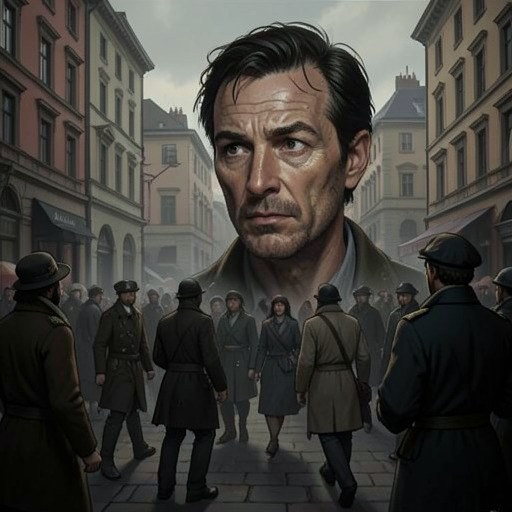
Partisans arrest and release Carlo Covasso
Foucault's PendulumThe arrest and release of Carlo Covasso is a wartime episode remembered by Jacopo Belbo, in which the partisan commander Mongo recognizes an opposing official not as an abstract representative of the regime but as a fellow soldier. The encounter does not erase the political conflict: it converts an arrest meant as a public lesson into a negotiated reprieve, revealing how shared military memory and an old code of honor can complicate factional allegiance.
Background and Arrest
In 1943, after Mussolini was removed from power, Uncle Carlo continued running the tax office for the Badoglio government. When the area later fell under the control of the Fascist Social Republic, he adjusted again and collected taxes for that regime. Belbo’s recollection presents this continuity as a matter of public duty and livelihood rather than declared political commitment: Carlo was a citizen of integrity and a servant of the state, and he had a family and a salary.
The local situation sharpened when Carlo’s neighbor Adelino Canepa boasted of contacts with partisan groups gathering in the mountains and threatened vengeance against regime representatives. The partisans’ arrival in town was disorderly and alarming: without uniforms, wearing blue kerchiefs, they fired into the air as residents locked themselves inside. At first, Carlo’s family assumed that Canepa’s claimed friendship with the partisans would protect Carlo. Instead, around eleven o’clock, a squad carrying automatic rifles entered the tax office, arrested him, and took him away without revealing his destination.
Mongo’s Decision
Carlo’s wife, Aunt Caterina, feared that the arrest would end in his death. A metal plate in his head meant that a blow from a rifle butt could kill him, and she collapsed into visible distress. Canepa came with his family, denied that he had informed on Carlo, and seemed to feel responsible for having talked too freely in town. After Carlo’s removal, Canepa’s protestations could not calm the household; Carlo’s mother kept a dignified silence, while Belbo cried.
The partisans had identified Carlo as a local representative of the regime and intended his arrest to teach the town a lesson. Taken by truck outside town, he was brought before Mongo, a former Carabinieri sergeant major who had lost a leg in the first fighting against the Fascists and the SS. Mongo stood with war medals shining, a gun in his right hand and a crutch in his left. Carlo, himself a disabled veteran, snapped to attention and introduced himself by rank, division, disability, and silver medal. Mongo answered in kind, identifying himself as Sergeant Major Rebaudengo, a former Royal Carabineer and commander of the Badoglian brigade Bettino Ricasoli, with a bronze medal.
Their exchange of battle locations made the old military connection concrete. Mongo had fought at Pordoi, hill 327; Carlo replied that he had been at hill 328, with the third regiment at Sasso di Stria. They remembered other battles together, including the fighting on Five-Finger Mountain and a bayonet attack on Saint Crispin’s Eve. At the shared impulse of recognition, the one-armed Carlo and the one-legged Mongo stepped forward and embraced. The brief reunion of two former soldiers changed the encounter’s terms: the captor and prisoner recognized each other through a history that preceded their opposed wartime positions.
Release and Terms
Mongo explained that the partisans had been told Carlo collected taxes for the Fascist government that served the invaders. Carlo answered that he had a family, received a government salary, and had not chosen which government held power. Mongo said that, in Carlo’s place, he would have done the same, but urged him to collect the taxes slowly and take his time. Carlo agreed to see what he could do, adding that he had nothing against the partisans and regarded them as fellow Italians and valiant fighters.
Their common devotion to the Fatherland, understood in the account as a shared ideal, allowed the conversation to reach a practical settlement without pretending the political disagreement had vanished. Mongo ordered his men to give Carlo a bicycle, and Carlo rode home. He returned about two hours after his arrest, looking as though he had been out for a picnic and asking what had happened when he saw the commotion in the garden. He went upstairs to Aunt Caterina, who was still agitated, and asked why she was so upset. Canepa did not show his face for several months.
Memory and Significance
Belbo later calls this episode the one heroic deed of his life. Its significance lies partly in the contrast between what the family feared—the sudden disappearance of a vulnerable man who might be killed with a single blow—and the unexpectedly quiet return on a bicycle. Yet the release is not a simple declaration that politics does not matter. The partisans arrest Carlo precisely because he collects taxes for the occupying regime; Mongo’s intervention instead makes room for a personal judgment grounded in shared service, military sacrifice, and mutual recognition.
The episode also becomes a measure of Belbo’s later sense of historical clarity. He remembers a world in which a bullet was unmistakably a bullet, a corpse a corpse, and the opposing sides seemed distinct, marked by red or black. In the later present, amid the Diabolicals’ falsehoods and the uncertain disappearance of Colonel Ardenti, such direct distinctions seem lost. The arrest and release thus survives in memory as an instance when history was brutally real but human relations were still legible: two disabled veterans could meet across opposing factions, recognize one another’s courage, and turn a sentence of political punishment into a limited accommodation.